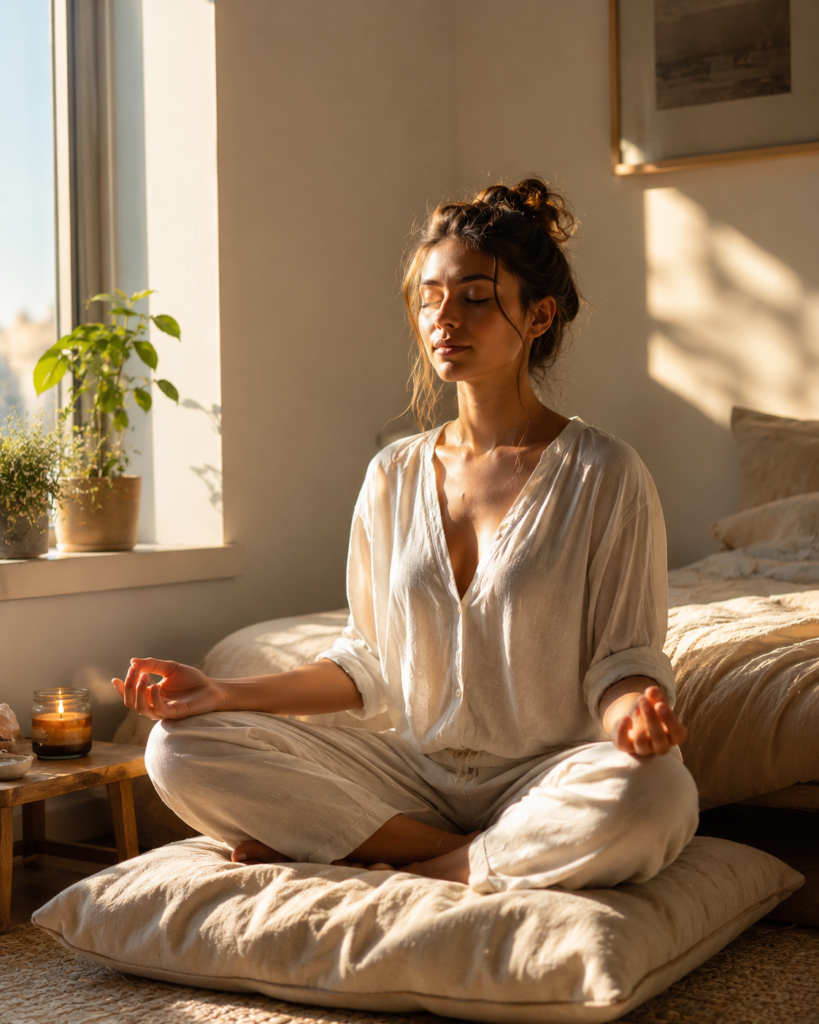
Want to meditate but don’t know where to start? This beginner’s guide covers everything — types of meditation, how to start, common mistakes, and how to build a consistent practice.
You sit down, close your eyes, and within thirty seconds your mind is somewhere else entirely — replaying a conversation from last week, drafting a grocery list, wondering if you’re “doing it right.” If this is your experience of meditation so far, you’re not failing. You’re actually meditating correctly, because noticing that your mind has wandered — and gently returning your attention — is the practice itself, not a sign you’re bad at it.
Most beginners quit within the first two weeks because they expect meditation to feel like instant calm, a blank mind, or some dramatic spiritual breakthrough. In reality, it’s closer to strength training for your attention: small, repeated reps that build capacity over time. The discomfort you feel in your first few sessions isn’t evidence that meditation “isn’t for you” — it’s evidence that your attention has never been asked to sit still before, and like any untrained muscle, it needs time to adapt.
This guide will walk you through what meditation really is, the seven major styles available to you, and a realistic five-step plan to build a practice that actually sticks — without the guilt, pressure, or need for perfection. By the end, you’ll also know exactly what to expect in your first thirty days, the mistakes that quietly derail most beginners, and how meditation can support a deeper spiritual or twin flame journey if that’s part of your path.
What Meditation Actually Is (and Isn’t)
Meditation is not about stopping your thoughts, achieving total silence, or floating into a trance-like state. At its core, meditation is the practice of intentionally directing and sustaining your attention — usually on the breath, a sensation, a sound, or a feeling — while training yourself to notice, without judgment, when your focus drifts.
It isn’t a religious requirement, a test you can fail, or something reserved for people who are naturally “calm.” You don’t need incense, a perfectly quiet room, or forty-five minutes of free time. You need consistency far more than you need the right conditions. Every time you notice your mind has wandered and bring it back, that’s not a failed attempt — that’s the mental “rep” that builds focus, self-awareness, and emotional regulation over time, much like a bicep curl builds muscle.
It also isn’t a one-size-fits-all activity. Some days meditation will feel expansive and peaceful; other days it will feel like sitting with a swarm of bees in your head. Both experiences are equally valid parts of the practice. The measure of a “successful” meditation session isn’t how calm you felt, but whether you showed up and practised returning your attention — the calm, when it comes, is simply a welcome side effect of that repeated skill.
7 Types of Meditation and Which Suits You
Mindfulness Meditation: The most widely practised style, mindfulness involves observing your thoughts, sensations, and surroundings as they arise, without trying to change them. It’s ideal for beginners because it requires no special technique beyond paying attention to the present moment — making it the most accessible entry point into meditation. Because it builds the foundational skill of non-judgmental awareness, most other meditation styles are essentially variations built on top of it.
Loving-Kindness Meditation (Metta): This practice involves silently directing phrases of goodwill — such as “may I be happy, may I be at peace” — first toward yourself, then toward a loved one, a neutral person, someone you find difficult, and finally all beings. It’s particularly powerful for people struggling with self-criticism, resentment, or relationship stress, as it actively cultivates compassion rather than simply observing the mind, gradually softening the inner critic many beginners carry.
Breathwork Meditation: Centred entirely on the breath — counting inhales and exhales, or using patterns like box breathing (4 counts in, 4 hold, 4 out, 4 hold) — this style is excellent for anxiety and stress relief because it directly engages the parasympathetic nervous system, offering a fast, physiologically measurable route to a calmer state within just a few minutes.
Body Scan Meditation: This involves slowly moving your attention through each part of the body, from toes to head, noticing sensations like tension, warmth, or tingling without trying to relax them on purpose. It’s especially useful for people who feel disconnected from their physical body, hold stress as muscle tension, or struggle with racing thoughts, since it gives the mind a concrete, sequential anchor to follow.
Mantra Meditation: Involves silently or audibly repeating a word, phrase, or sound — such as “Om,” “So Hum,” or a personal affirmation — to occupy the thinking mind and deepen focus. It suits people who find open awareness difficult, since the repeated sound gives restless minds something structured to hold onto, and it’s a technique that translates well into everyday moments like commuting or waiting in line.
Visualisation Meditation: This style uses mental imagery — picturing a peaceful place, a desired outcome, or healing light moving through the body — to guide the mind toward a specific emotional or spiritual state. It’s popular among people working on manifestation, goal-setting, confidence-building, or emotional healing, since the brain often responds to vividly imagined scenarios in ways similar to real experience.
Movement Meditation: For those who find stillness uncomfortable, walking meditation, gentle yoga, or tai chi offer a way to cultivate present-moment awareness through slow, deliberate movement rather than sitting still. It’s an excellent starting point for restless beginners, people who process emotion better through the body than through stillness, or anyone who associates sitting quietly with anxiety rather than calm.
How to Start a Meditation Practice in 5 Steps
1. Choose a consistent time: Anchor your practice to an existing habit — right after waking up, before brushing your teeth at night, or during your morning coffee. Consistency of timing matters more than the specific time you choose, because it turns meditation into an automatic cue rather than something you have to remember and negotiate with yourself daily.
2. Pick a dedicated space: You don’t need a meditation room — a corner of your bedroom, a chair by a window, or even your car during a lunch break works fine. What matters is returning to the same spot repeatedly, since your brain begins to associate that physical location with a settled, focused state.
3. Start absurdly short: Begin with just 3 to 5 minutes. This isn’t a compromise — it’s a strategy. A short session you actually complete builds more long-term consistency than an ambitious 20-minute session you dread and eventually skip.
4. Pick one technique and stick with it: Choose a single style from the list above — mindfulness or breathwork are the easiest starting points — and commit to it for at least two weeks before trying something new. Switching techniques constantly prevents you from building real familiarity with any one method.
5. Track it, don’t judge it: Use a simple habit tracker or journal to mark each day you meditate, regardless of how “good” the session felt. The goal in the early weeks is showing up, not achieving a particular mental state — consistency compounds far more powerfully than intensity. A visual streak, even a simple row of checkmarks on a calendar, can be surprisingly motivating during the early weeks when the internal benefits aren’t yet obvious.
What to Expect in Your First 30 Days
Days 1–7: Expect restlessness and a very loud inner monologue. Your mind will feel busier than usual — not because meditation is making it worse, but because you’re finally paying attention to noise that was always there. Sessions may feel awkward or unproductive; this is completely normal and not a sign to quit.
Days 8–14: You’ll likely notice brief, fleeting moments of stillness between thoughts — a few seconds where your mind feels quiet. Some people also notice slightly improved patience or reduced reactivity in daily life, though it may be subtle enough that you’re not yet sure if it’s “working.”
Days 15–21: This is typically when consistency starts to feel easier and more automatic, rather than something you have to force. You may notice you’re catching your wandering thoughts faster and returning to focus with less frustration, a small but meaningful shift in mental agility.
Days 22–30: Many beginners report a noticeable difference in baseline stress levels, sleep quality, or emotional reactivity by this point. Meditation starts to feel less like a task and more like a genuine tool you reach for — the foundation of a practice that can keep deepening well beyond the first month.
It’s worth noting that progress in meditation is rarely linear. You may have a wonderfully still session on day 12 and a frustrating, fidgety one on day 13 — this is entirely normal and doesn’t mean you’ve regressed. What matters over thirty days isn’t the quality of any single session, but the cumulative effect of simply showing up again and again.
Common Mistakes Beginners Make
Almost every beginner who quits meditation does so for one of a small handful of predictable reasons — not because meditation “doesn’t work for them,” but because their expectations were misaligned with how the practice actually unfolds. Recognising these patterns in advance makes it far easier to push through the early, awkward weeks.
Expecting total silence: Many beginners believe successful meditation means achieving a completely blank, thought-free mind. In reality, thoughts are a normal part of the process — the goal isn’t the absence of thoughts, but a different relationship to them, where you notice them without getting swept away.
Trying to forcefully stop thoughts: Fighting your thoughts creates more mental tension, not less. Instead of forcing thoughts away, the more effective approach is to acknowledge a thought’s presence, let it pass like a cloud, and gently redirect attention back to your anchor — whether that’s breath, sound, or sensation.
Doing too much, too soon: Jumping straight into 30-minute sessions is one of the fastest ways to burn out on a new practice. Long, ambitious sessions before you’ve built the habit often lead to frustration, boredom, or physical discomfort, which makes it far more likely you’ll abandon the practice altogether. Building duration gradually, once consistency is established, is far more sustainable.
Other common pitfalls include comparing your experience to other people’s (everyone’s mind behaves differently), meditating only when stressed rather than consistently, and quitting after a few “bad” sessions instead of recognising that inconsistency, not difficulty, is what actually derails most beginners. Many people also make the mistake of judging a session’s success by how they feel in the moment, rather than by whether they showed up at all — but it’s the showing up, repeated over weeks, that produces the lasting benefits.
Meditation for Twin Flames and Spiritual Seekers
For those on a twin flame journey or a broader path of spiritual awakening, meditation becomes more than a stress-relief tool — it becomes a direct line of communication with your higher self and your intuition. Many people also experience physical and energetic changes commonly associated with Kundalini awakening. Twin flame connections are often intensely energetic, and stilling the mind allows you to sense subtle shifts, synchronicities, and emotional pulls that are easy to miss in the noise of daily life.
A simple practice for spiritual seekers is to begin each session by setting an intention to connect with your higher self, then spend several minutes in silent breath awareness before visualising a cord of light connecting your heart centre to your twin flame or spiritual guide. This isn’t about forcing contact or manifesting a specific outcome — it’s about creating the internal stillness needed to receive guidance clearly, without the interference of fear, doubt, or attachment.
Sending loving-kindness meditation toward your twin flame, or toward the relationship itself, can also help clear emotional blocks like resentment, impatience, or anxiety that often arise during periods of separation or spiritual growth. Many spiritual seekers find that consistent meditation doesn’t just calm the mind — it accelerates the process of releasing old patterns that no longer serve the connection, making space for genuine union or, at minimum, deep personal healing.
It’s also worth approaching this practice with patience rather than urgency. Spiritual meditation is not a shortcut to forcing a particular outcome with another person — it’s a tool for deepening your relationship with yourself first, so that whatever unfolds externally, whether reunion, continued separation, or eventual release, meets you from a place of groundedness rather than desperation. The more consistently you meditate, the easier it becomes to distinguish authentic intuitive guidance from anxious projection, a distinction that becomes especially valuable during the more turbulent phases of a twin flame journey.
If you’re navigating the ups and downs of a twin flame connection, this practice pairs powerfully with a deeper understanding of the twin flame journey as a whole — including the stages of separation, awakening, and reunion.
Related Articles
Healing Old Emotional Wounds Through Mindfulness: A Path to Emotional Freedom
Meditation doesn’t require a perfectly quiet mind, unlimited free time, or a special spiritual gift — it requires showing up, imperfectly, on a consistent basis. Start small, choose one technique, anchor it to an existing habit, and give yourself permission to have “bad” sessions without quitting. Over the first thirty days, you’ll likely notice subtle but real shifts in your patience, focus, and emotional steadiness.
Whether your goal is stress relief, spiritual connection, or simply a quieter mind, the practice that sticks is always the one you actually do — not the one you think you’re supposed to do. Give yourself thirty days of imperfect, consistent effort before deciding whether meditation “works” for you, and trust that the small, unglamorous act of sitting down each day is, in itself, the entire practice.