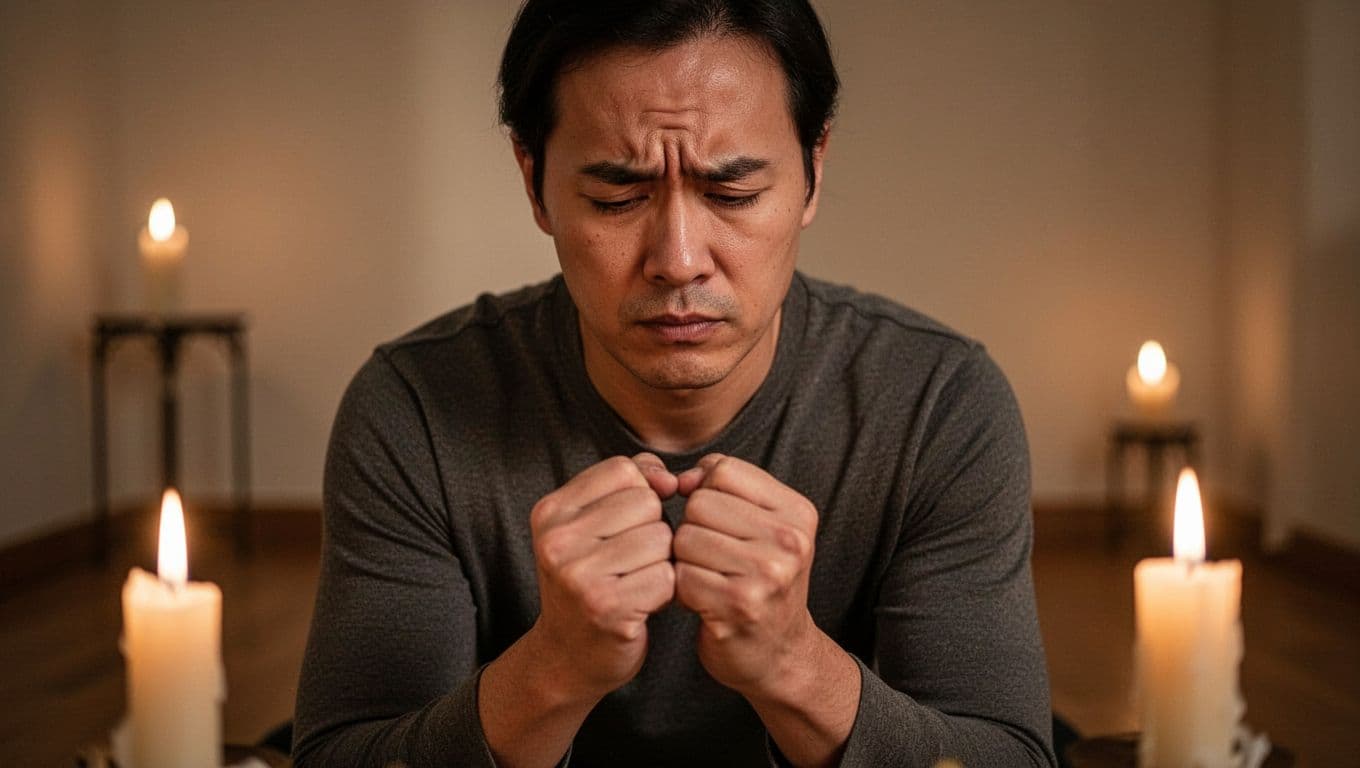
You kneel, sit, whisper, or repeat the same prayer you have said a hundred times. The words are right. The tone is respectful. Yet nothing inside you shifts, and nothing outside seems to move either.
That can feel confusing, even painful. Many spiritual traditions teach that prayer is shaped less by polished language and more by sincerity, intention, emotion, and inner alignment. Science has not shown prayer works in a repeatable lab way, but that still doesn’t settle what prayer means in lived experience. The deeper issue is often the state behind the words.
Why the energy behind your prayer shapes the experience
When people talk about the “energy” of prayer, they usually do not mean physics. They mean your inner condition while praying, your focus, honesty, trust, attention, and emotional tone. In plain terms, your prayer carries whatever is alive in you.
That matters because prayer is not only speech. It is also presence. If your mouth says, “I trust you,” while your body is tight with panic, your experience of prayer may feel split. The prayer is still real, but it may feel cloudy because you are not fully there.
Christian, Islamic, Hindu, Buddhist, and other spiritual teachings often point to the same truth. Prayer changes you most when your heart and mind are involved. In that sense, prayer is less like filling out a form and more like opening a door.
Words can sound faithful while your heart says something else
Many people pray while carrying fear, anger, shame, or resentment. That is human. It does not make you bad at prayer.
Still, mixed feelings change the experience. You can say hopeful words while expecting loss. You can ask for peace while replaying old wounds. You can sound devoted while secretly performing for an image of what a “good” believer sounds like.
When that happens, prayer can feel flat. The problem is not imperfect emotion. The problem is disconnection from what is true.
Prayer often becomes clearer when your spoken words and inner life stop pulling in opposite directions.
Real prayer asks for connection, not control
A lot of frustration comes from treating prayer like a direct order. Ask correctly, then expect a result. Most spiritual traditions do not describe prayer that way.
They describe prayer as surrender, devotion, listening, and inner alignment. You bring your need, but you also bring your willingness to be changed. That shifts prayer from control to relationship.
For many believers, outcomes are shaped by more than desire alone. Timing matters. Other people’s free will matters. God’s will matters. So prayer is not a machine that dispenses what you request. It is a meeting place where you come honestly before something greater than yourself.
What blocks prayer, even when you mean every word
Sometimes you truly mean what you say, yet prayer still feels closed off. That does not always mean you are doing something wrong. It may mean certain habits or inner tensions are getting in the way.
Mechanical prayer can numb the meaning
Routine can help prayer become part of daily life. Repeated prayers, sacred phrases, and memorized lines can be beautiful. The problem starts when repetition loses contact with attention.
You may finish a prayer and realize you barely noticed it. Your lips moved, but your mind stayed elsewhere. Over time, that can numb the meaning.
Repetition itself is not empty. Emptiness comes from absence. If you slow down, breathe once or twice, and say each line with awareness, even a familiar prayer can feel alive again. A prayer spoken with attention lands differently than one spoken on autopilot.
Hidden motives can weaken trust
Another block is the pressure to force an outcome. You may pray for a person to stay, a job to open, a test to be clear, a diagnosis to change. Those desires are human and tender. There is no shame in bringing them to prayer.
Yet prayer tightens when the only goal is to get a specific result. Desperation can turn prayer into bargaining. Fear can turn it into grasping.
A fuller prayer makes room for more than the request. It also asks for wisdom, peace, courage, patience, and acceptance. That does not weaken faith. It often strengthens trust, because you are no longer trying to bend reality with words alone.
How to pray with more honesty, peace, and spiritual alignment
If prayer feels blocked, the answer may be simpler than you expect. You may not need better language. You may need a calmer body, a truer sentence, and more room for surrender.
Settle your body first so your words can mean something
Prayer begins before the first word. Sit down. Unclench your jaw. Let your shoulders drop. Breathe slowly for a minute.
That short pause matters because the body carries panic long after the mind says, “Calm down.” When the body softens, intention often becomes clearer. Then your prayer is less frantic and more present.
A brief moment of gratitude can help too. Thank God for one thing, even if the day feels hard. Gratitude does not erase pain, but it opens space around it.
Use simple words that match what you truly feel
You do not need to sound holy. Plain words are often stronger.
Say, “I’m scared.” Say, “I don’t know what to do.” Say, “Part of me trusts, and part of me is tired.” That kind of honesty can bring more life to prayer than a polished paragraph.
Many people hide doubt from God as if doubt were a failure. Yet honest doubt is still honest prayer. If your heart is confused, let the prayer sound confused. Truth creates contact.
Stay open to an answer that looks different from your request
This is often the hardest part. You pray for one door, and another opens. You ask for change outside yourself, but the first change happens within you.
Many faith traditions hold space for delay, redirection, inner growth, and sometimes a painful “no.” That does not make disappointment easy. Still, it can keep prayer from collapsing when life does not match the request.
Science offers a helpful boundary here. The large STEP study, published in 2006, found no consistent healing effect from intercessory prayer in heart surgery patients. Later reviews have stayed mixed, and no major 2025 or 2026 breakthrough study has changed that. At the same time, research has found more support for personal prayer helping the person praying through lower stress and better mental calm. A lab can measure complications and heart rate. It cannot fully measure surrender, meaning, repentance, trust, or the felt sense of being held.
Prayer may feel stuck because the issue is not your wording. More often, it is the inner state carrying the words.
When you pray with sincerity, presence, humility, and emotional honesty, something real happens, even if the outcome is not immediate or obvious. The invitation is simple: pray less like you are reciting, and more like you are relating.