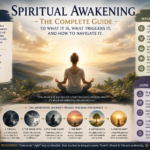
You wake up, move through the day, answer messages, maybe even smile, yet something inside feels scorched and empty. The life that once fit now hangs on you like borrowed clothes. Many people call this a dark night of the soul.
The phrase comes from St. John of the Cross, a Christian mystic, yet the experience now shows up across many faiths and spiritual paths. On the surface, it can look a lot like depression. Still, for some people, it is also part of a spiritual awakening, a hard inner breaking open.
That said, spiritual ideas should never replace medical or mental health care. If your symptoms are severe, persistent, or unsafe, get professional help right away.
What the dark night of the soul really means
In plain English, the dark night of the soul is a period when your old way of living stops making sense, but the new way has not arrived yet. You may lose interest in things that once gave comfort. Prayer can feel dry. Meditation can feel blank. Even your goals may start to look thin and strange.
St. John of the Cross described two stages, the “dark night of the senses” and the “dark night of the spirit.” You do not need the full theology to understand the feeling. First, the usual comforts stop working. Later, even deeper beliefs and images of yourself may fall apart. A simple overview of the tradition appears in this background on the dark night experience.
What makes this state so hard is the loss of inner control. You may feel cut off from meaning, from God, from certainty, or even from your own personality. The old self does not fully hold. The new self has not formed.
Why this season can feel painful, empty, and strangely important
Most people read pain as a sign that something is wrong. Sometimes that is true. Yet this kind of pain can also come from shedding what no longer fits. Roles, beliefs, and habits that once held you together may start to crack.
That cracking feels raw because it touches attachment. You might release the need to be admired, needed, productive, correct, or spiritually “good.” When those supports fall away, the nervous system often protests. As a result, the dark night can feel like loss, failure, and exile all at once.
The pain often comes from outgrowing a life that once kept you safe.
There is a reason many people confuse this phase with a collapse. In one sense, it is a collapse. Yet it may also be a clearing. What leaves is often false certainty, not your worth.
Signs you may be going through a spiritual awakening
A spiritual awakening does not always feel bright, blissful, or peaceful. Sometimes it begins in ash. The outer shape of your life may stay the same, while your inner world starts refusing old lies.
A helpful cross-traditional field guide describes this season as a dissolution of what you built your inner life on. That wording fits because the shift often feels less like learning something new and more like losing what used to prop you up.
Your old goals, habits, and labels suddenly feel hollow
This is often the first sign people notice. Career success, praise, status, routines, and social approval stop feeding you. You may still function, but the spark is gone. The life you worked hard to build can start to feel strangely flat.
Often, this change follows a shock. Grief, burnout, illness, divorce, job loss, caregiving, or a move can tear a hole in the story you told yourself. Through that hole, deeper questions rush in. You stop asking, “How do I win?” and start asking, “Why am I living this way at all?”
That does not mean you have become lazy or broken. It may mean your soul no longer wants to live on borrowed values.
You feel like your identity is breaking apart
People sometimes call this ego death, but the plain version is easier to grasp. You no longer know who you are in the old way. The roles that named you, parent, achiever, helper, believer, healer, strong one, stop feeling stable.
This can be frightening because identity gives life shape. Without it, you may feel exposed and unreal. You can seem fine on the outside while feeling unmade on the inside.
Still, there is often an honest quality to this pain. The false self struggles to survive, while the deeper self waits without much language. Many people in this stage feel less interested in performing and more drawn to truth, even when the truth hurts.
Part of you senses change, even in the middle of the pain
This is one of the clearest clues. A dark night may bring grief, numbness, fatigue, tears, and loneliness. Yet somewhere inside, a small current still moves. You may feel pulled toward prayer, silence, truth-telling, surrender, rest, or repair.
The pain remains real. However, total hopelessness is not always the center of it. Small openings still happen. A quiet walk helps. A page in a journal lands with force. A line in a book meets you at the exact right hour. Some people report brief moments of peace that arrive for no obvious reason. Others feel a slow urge to become more honest, less defended, less fake.
That inner pull matters. It does not prove anything on its own, but it can point toward awakening rather than only shutdown.
How this differs from clinical depression, and where they can overlap
This part needs care. A dark night of the soul and clinical depression can share many signs: sadness, numbness, low energy, withdrawal, trouble enjoying life, and loss of meaning. Because of that overlap, self-diagnosis is risky.
A useful discussion from Psych Central on depression and dark night of the soul makes the same point. The outside can look similar, while the inner structure may differ. Real-time mental health and spiritual guidance in 2026 still stress that both experiences can also happen together.
A spiritual crisis often carries a search for truth, while depression can flatten everything
The main difference is often the inner tone, not the surface symptom. In a spiritual crisis, the pain may carry movement. You feel stripped, but also drawn. You grieve, yet some part of you still wants truth, healing, or God. The suffering can feel like a hard passage.
Depression often feels more shut down. Hope drops. The future can look sealed off. Meaning does not hide in the distance; it disappears altogether. Some people describe a spiritual dark night as empty but alive, while depression can feel heavy, colorless, and stuck.
Even so, that contrast is not absolute. Some people move between both states. Others experience spiritual loss that becomes depression because the strain lasts too long.
When to reach out for a doctor, therapist, or crisis support
Please take this seriously. If you have suicidal thoughts, feel at risk of self-harm, cannot function, stop eating, barely sleep, panic often, misuse substances, or live with ongoing despair, reach out for professional help now.
A careful reflection from Contemplative Outreach on dark night and clinical depression makes room for both spiritual discernment and mental health care. You do not have to choose one or the other. Therapy, medication, spiritual direction, prayer, and community can work side by side.
Getting help is a sign of clarity, not a sign that your spiritual life has failed.
What helps you move through the dark night without getting lost
You do not need grand answers during this season. Usually, you need steadiness. The goal is not to force insight. The goal is to stay safe, grounded, and honest while the inner shift unfolds.
Choose gentle practices that create safety and space
Simple habits often help more than intense ones. Try writing a few honest lines each day. Sit in silence for five minutes instead of forcing a long meditation. Walk outside without headphones. Pray if prayer still feels possible. If it does not, sit anyway.
Rest matters more than many people think. So do simple meals, less screen noise, steady sleep, and fewer draining commitments. Breathwork can help, but keep it light if your body is already tense. You are not trying to manufacture revelation. You are making enough room for truth to breathe.
Find wise support instead of trying to carry it alone
The dark night can make you want to hide. Yet safe company is often part of the healing. That may mean a trauma-aware therapist, a grounded spiritual director, a support group, or one close friend who does not rush to fix you.
Online advice can blur spiritual awakening and mental illness in risky ways. Discernment matters. A thoughtful piece on spiritual direction during a dark night speaks to the value of being witnessed without judgment. That kind of support can keep you from mistaking every hard feeling for enlightenment, or every spiritual loss for pathology.
This season can feel like winter inside your own chest. Even so, winter is not proof that life is gone. Sometimes it is the field lying bare before new roots take hold.
What feels like emptiness may be a stripping away before a fuller peace, faith, or self returns. Hold that hope gently, and keep one hand on reality. If you need help, reach for it. Wisdom often looks like support, not solitude.