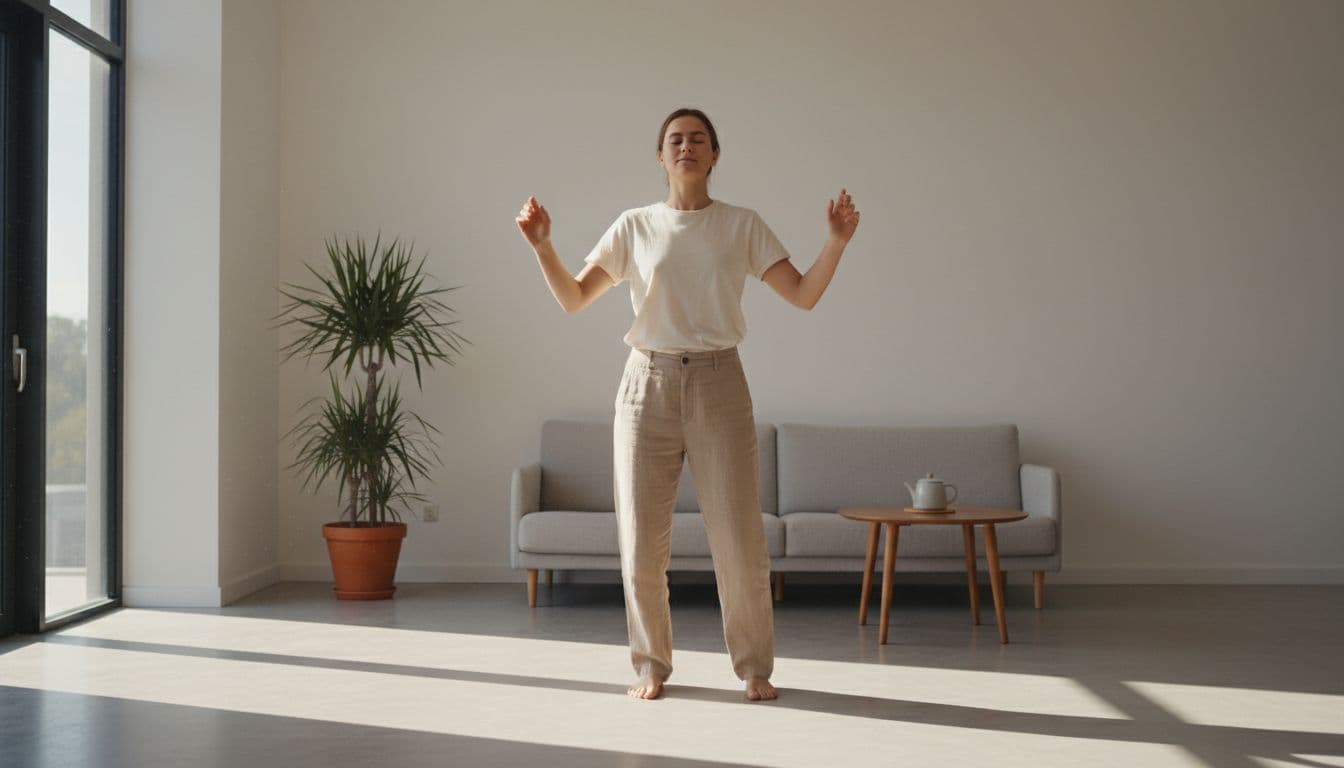
You wake up, and yesterday is still sitting in your shoulders. Your jaw feels locked, your chest feels crowded, and your body acts like the hard part never ended.
That leftover tension is common. Stress can leave your mind, yet stay in your muscles, your breath, and your nerves. Shaking exercises give that stress somewhere to go, and they do it fast.
You don’t need gear, floor space, or a long routine. These three simple movements take about a minute and can help you feel more settled before your day starts.
Why shaking helps your body let go of stress
Stress is not only a thought. It’s also a body state, and the body often lags behind the clock.
When something stressful happens, your system shifts into fight-or-flight. Muscles brace, breathing gets shallow, and your body prepares to act. If you never get to move that energy out, some of it hangs around like static.
What happens in the body when stress builds up
You can feel this buildup in familiar places. The shoulders lift and stay there. The jaw presses shut. The belly tightens. Breaths get short and live high in the chest.
Sometimes it shows up as restlessness. You pace, tap your foot, scroll your phone, and still feel wired. Other times it feels heavy, like you’re wearing a damp coat you can’t peel off.
This is why a tense day can follow you into the next morning. The meeting is over, the argument is done, yet your body still acts as if it needs to protect you.
Why small movements can make a big difference
Gentle shaking helps because it gives the stress response a physical exit. The motion loosens muscle tension, uses up some leftover adrenaline, and tells the nervous system that the threat has passed.
It also works because the body likes simple signals. Soft movement, loose joints, and easy breathing create a sense of safety faster than overthinking does. You are not trying to perform anything here. You are letting the body stop bracing.
That simple body logic is why the practice feels so immediate. Healthline’s look at shaking and stress notes that gentle trembling may help release muscular tension and excess adrenaline, while also pointing out that research is still growing. For everyday stress, though, many people can feel the shift in under a minute.
The one-minute shaking routine you can do almost anywhere
This short sequence is a reset, not a workout. Stand with your feet about hip-width apart, unlock your knees, and let your jaw stay soft. Spend around 15 to 20 seconds on each part, then move to the next.
Start with a soft foot bounce to wake up your legs
Begin with both feet flat on the floor. Bend your knees a little, keep your hips easy, and let your body make a tiny bounce. The heels can stay light and loose.
The movement should feel springy, not hard. You’re not jumping. You’re letting the legs absorb and release a small pulse, like a quiet ripple moving through your calves and thighs.
Stay here for 15 to 20 seconds. If it helps, imagine tension draining down through your legs and into the ground. That image can make the motion feel more natural, especially when you’re stiff first thing in the morning.
Shake out your hands and arms to release upper-body tension
Now let your arms hang by your sides. Shake your hands and wrists as if you just washed them and want to flick off the water. Then allow the motion to travel into your forearms and elbows.
Keep your shoulders low. If they creep upward, breathe out and let them drop. Many people notice that when the hands loosen, the jaw starts to soften too. That’s because upper-body tension often travels as a group.
This part is great after typing, driving, or sitting through stress with a fixed posture. It can also help when nervous energy makes you feel buzzy and stuck. Bustle’s explainer on somatic shaking describes why people often find this kind of movement grounding when daily stress leaves them feeling trapped in fight-or-flight.
Finish with a full-body shake to clear the leftover stress
For the last 20 seconds, keep the knees soft and let the bounce spread. The movement can travel through the legs, hips, spine, shoulders, and head, if that feels comfortable.
Think loose, not large. A good full-body shake looks less like exercise and more like the body finally exhaling. Let the arms wobble a little. Let the chest move without force. Let your face stay easy.
If you want, sigh out through the mouth once at the end. Then stand still for a breath or two and notice what changed. Often the first thing you feel is space, more room in the ribs, more slack in the jaw, more weight in the feet.
The best shake is the one that feels easy enough to trust.
How to make the exercise feel safe and effective
A minute goes further when the movement feels calm instead of forced. Small adjustments in breath and posture can turn a quick shake into a true reset.
Use slow breathing so your body knows it can relax
Keep breathing through your nose if that feels comfortable. Try a simple pattern, inhale for three or four counts, then exhale for five or six. The longer exhale helps many people settle faster because it tells the body there is no rush.
Don’t hold your breath while you shake. That tends to add effort and can make you feel more wound up. Instead, let the breath ride under the movement like a slow current under a boat.
If you want a slower version beyond this one-minute routine, this guide to somatic shaking walks through the wider practice and offers a beginner-friendly pace.
Keep the movement light, loose, and unforced
Soft knees matter. A relaxed jaw matters too. When either one locks up, the whole body often follows.
Try to move at about 30 percent effort. Bigger is not better here. Hard shaking can make you brace more, while an easy bounce often helps the nervous system settle. The sweet spot is loose enough to feel natural and steady enough to feel safe.
It’s also fine if your body wants a tiny sway instead of a shake. Some days the motion is obvious. Other days it’s barely there. Both count. Comfort is a better guide than form.
If anything feels sharp, painful, or strange, stop and adjust. This should bring relief, not strain.
When to use shaking and who may want to be careful
This kind of body reset fits into ordinary life. You don’t need a special mood, and you don’t need to wait until stress turns into a full meltdown.
Good times to try a quick shake-out
Use it after a hard meeting, after a long commute, or after doom-scrolling in bed. It also helps between tasks, before a tough conversation, or when you wake up tense and don’t want to carry that feeling into the day.
Many people like it after work because the body often holds the day long after the laptop closes. Others use it before sleep to take the edge off a wired, tired feeling. It works best when your mind has moved on, but your body hasn’t.
Simple reasons to slow down or skip the routine
Ease off if you feel dizzy, unsteady, or short of breath. Skip it, or switch to a seated version, if you have pain, a fresh injury, balance issues, or any condition that makes standing movement uncomfortable.
You can also place one hand on a wall or countertop for support. If you have a health concern and are unsure, check with a doctor or physical therapist who knows your situation. Listening to your body is part of the practice.
A calmer day can start with 60 seconds
Yesterday’s stress often shows up before your thoughts do. It lands in the jaw, the chest, the shoulders, and it asks your body to carry more than it needs.
A soft foot bounce, a quick arm shake, and a loose full-body tremor can interrupt that pattern. Small resets count, especially when they help your body feel safe again.
The next time you wake up tense, try the minute before you reach for your phone. Sometimes 60 seconds is enough to give your day a different tone.
stress relief, somatic shaking, nervous system, body reset, tension release